How to check a forex signal record, row by row
Reconcile original calls, broker observations, amendments, unresolved exposure and actual subscriber fills.
Choose which history you are checking
A forex call history, a source trading account and a subscriber account are different populations. Name the one under review before opening a spreadsheet. A publisher may have delivered valid instructions while a customer missed them; a source account may have traded positions that never appeared in the subscription. Neither history automatically fills the gaps in the other.
Specify the service, interval, timezone, pair universe and eligible call rule. Keep cancelled and unresolved ideas visible. If historical coverage cannot be established, describe the available subset rather than publishing a precise all-service accuracy rate from whatever rows happened to survive.
Platform documentation does not erase account differences
MetaTrader's official subscription documentation identifies symbol-availability and volume-condition mismatches as copying concerns. It describes its own settings and synchronisation process, not an assurance that all source and subscriber trades match. Read the exact platform rules alongside the broker and account configuration.
For manual alerts, capture the time the original message became available to you, not only the author's timestamp. Record the quote source and whether a level refers to bid, ask or another observation. A broker-specific executable price cannot be reconstructed from an unlabelled chart image.
A delayed-entry arithmetic example
Take a fictional long idea with desired entry 1.1000, stop 1.0960 and target 1.1080. Under a simplified price-distance convention, the original reward is 80 pips and planned risk is 40 pips, using a 0.0001 pip. If the assumed fill is 1.1010, reward becomes 70 pips and planned risk 50 pips.
The respective ratios are 2.0 and 1.4 before spread, fees, financing and any stop slippage. These are invented prices, not live quotes or a suitable trade. The calculation demonstrates that preserving the original target and stop while changing entry changes the interpretation; it does not predict either exit.
Treat revisions as events
Attach each amended entry, stop, target or expiry to the original call identifier with its own observed time. Do not overwrite the initial instruction. A stop moved after an adverse quote is a later policy decision, not evidence that the original stop was never relevant. Where sequencing is unavailable, label the reconstruction indeterminate.
Partial exits need quantities or a declared weighting policy. Three targets on one idea should not become three independent winners while a stopped idea counts once. Preserve the exposure remaining after each event so a closed balance summary cannot conceal a position still at risk.
Reconcile outcomes before rates
For a made-up batch of twelve closed wins, eight closed losses and five open ideas, the closed-only rate is 60%. Closed wins are 48% of all twenty-five ideas, but that is not the same metric and assigns no outcome to the open five. State both definitions if useful; never interchange their labels.
Monetary evidence additionally requires size, prices, costs, cash flows and account currency. Winning frequency cannot establish expectancy when gain and loss sizes are unknown. A personal account return should be reconstructed from account records under a disclosed convention, not by adding favourable pip headlines from unrelated calls.
Publish a bounded evidence conclusion
A reviewable package contains original messages or permitted records, an amendment ledger, observation sources, outcome rules and a dated exception list. A timestamp proof can support a content-timing claim; coverage and executable fills still need separate evidence. If the full population is missing, retain that limitation in the headline interpretation.
A useful conclusion names the rows reconciled and the fields still unavailable. It does not call the service audited simply because a spreadsheet adds up. This protocol performs no paid-account tracking and gives no expected return; it makes the next evidence request precise enough for a reader to reproduce.
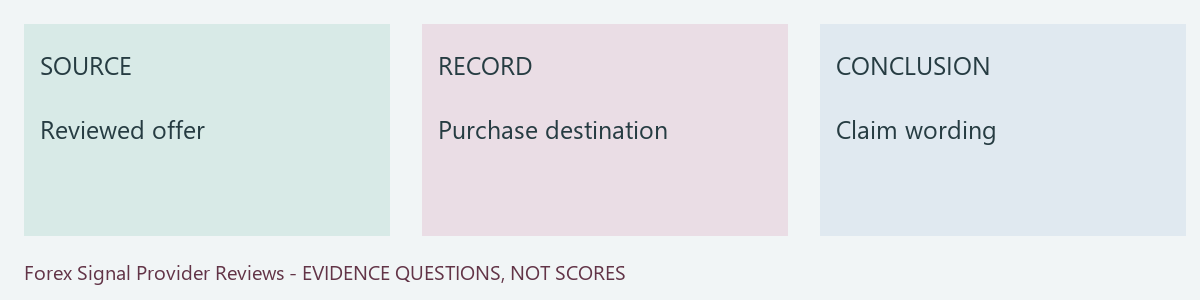
Evidence handoff
| Check | Record | Boundary |
|---|---|---|
| Original call | Message, pair and entry condition | No later edit replaces it |
| Subscriber order | Received time and actual broker fill | Author price is a separate reference |
| Outcome | Quantity, costs and unresolved exposure | Closed rate is not account return |
 Blank evidence CSV
Column definitions: service, call_id, pair, broker, quote_convention, published_at_utc, received_at_utc, entry_condition, expiry, original_stop, original_target, revision_id, quantity, actual_fill, costs, outcome_state.
No example trade or user record is stored in the download. Keep credentials and personal account identifiers out of shared copies.
A worked conversion boundary
FX-B's fictional short produces offsetting JPY price components but uses separate entered conversions for its realised reduction and open mark. Its account-currency components therefore do not offset exactly before costs. Keeping both native and converted figures allows the convention to be inspected. A real reconstruction would need its own rate sources and account events rather than a silently substituted reference series.
Inspect a full worked lot and conversion record
The four-position packet retains original lots, declared contract size, three reduction events, per-event conversion, account-currency cost debits and remaining exposure at a fixed UTC cutoff. The order cases retain wanted and floored lots with explicit pip and tick conventions. Their numbers are invented, not provider or subscriber records. Inspect both native quote components and converted account components before comparing the total. A complete real evaluation needs its own relevant instructions, quantity events, prices, costs and rate basis rather than borrowed fictional values.